ChatGPT is now a paid ad channel you can buy yourself. This week my inbox had an invite from OpenAI: ChatGPT Ads Manager is available on my account. For anyone running Google, Meta or Microsoft Ads, that is a new place to reach buyers while they are actively deciding.
OpenAI says more than 1 billion people use ChatGPT regularly to answer questions, get work done, make decisions and discover products. The pitch is simple: show up inside that decision, not after it.
Here is what the platform actually offers today, who should test it first, and how to avoid the tracking mistakes that waste early budget on every new channel.
What ChatGPT Ads Manager is
ChatGPT Ads Manager is OpenAI’s self-serve portal for buying ads inside ChatGPT. Businesses register as advertisers, add billing, set budgets, bids and pacing, upload ads, launch campaigns and view performance in one place (OpenAI).
It moved fast in 2026:
When | What changed |
|---|---|
May 2026 | Ads pilot expansion announced for the UK, Mexico, Brazil, Japan and South Korea (Shopifreaks) |
May 5, 2026 | Beta self-serve Ads Manager for U.S. advertisers, plus CPC bidding and new conversion measurement (TechWyse) |
April 2026 | Minimum spend commitment lowered to $50,000 |
February 2026 | Pilot launch with selected advertisers; minimums as high as $250,000 |
Before self-serve, advertisers had to go through OpenAI’s sales team or large agency holding companies. Now a small business can open an account directly. OpenAI’s monetization lead has said the minimum spend commitment goes away as access opens to all advertisers (TechWyse).
How buying works
You pick an objective, and the objective decides how you pay.
Objective | You pay per | Best for |
|---|---|---|
Reach | 1,000 impressions (CPM) | Awareness, testing demand |
Clicks | Click (CPC) | Traffic you can tie to sales or leads |
CPC is the big change. During the early pilot, ads were bought on a CPM basis only (Axios). Paying per click puts ChatGPT closer to how performance marketers already buy Google Search.
On measurement, OpenAI added a pixel and a Conversions API (CAPI) alongside the Ads Manager launch (Aimerce). That means you can send purchases and leads back to the platform, the same way you would with Meta CAPI or Google Enhanced Conversions.
Two current limits worth knowing: ads stay clearly labeled and separate from ChatGPT’s answers, and there is no MCC-style view yet, so agencies switch between client accounts one at a time (Search Engine Land).
Why conversational intent is different
A ChatGPT user often tells you more than a searcher does. A Google query is three or four words. A ChatGPT prompt is often a full brief: budget, use case, location, constraints.
Channel | What you know about the person | Typical moment |
|---|---|---|
Google Search | A short keyword | Looking for a page or a product |
Meta | Interests and behavior | Scrolling, not looking |
ChatGPT | A detailed problem in their own words | Comparing options and deciding |
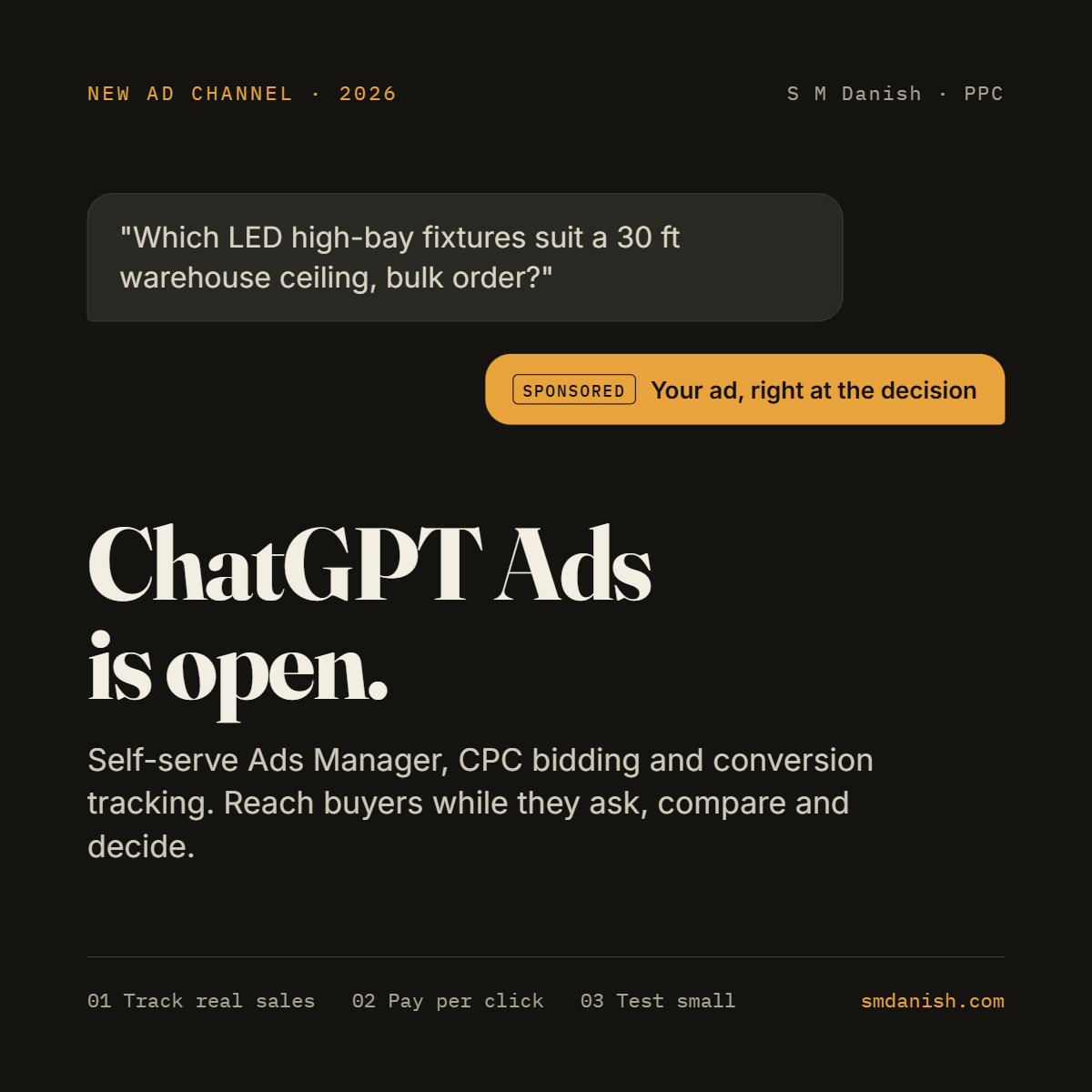
Take a facility manager asking which high-bay LED fixtures suit a 30-foot warehouse ceiling on a bulk order. That is a buyer, not a browser. An ad that answers that exact need can land at the moment of decision.
The flip side: this channel is new, and nobody has years of benchmark data on CPCs or conversion rates yet. Early tests are for learning, not for scaling.
Who should test it first
Businesses whose buyers research before they buy should test now. Others can wait a quarter and learn from early results.
Good early fits
- B2B suppliers with considered purchases (equipment, software, industrial supplies)
- High-value services where people compare options: dental implants, cosmetic and medical treatments, legal, home renovation
- Ecommerce stores with clear product specs that answer comparison questions
Better to wait
- Accounts with no working conversion tracking on Google or Meta yet
- Very small budgets that cannot fund a 30-day learning test
- Impulse or low-ticket products where search and social already convert cheaply
Access is still rolling out by country, so check whether your Ads Manager account can target the markets you actually sell in before planning a budget.
Lessons from Google Ads: tracking before scale
The biggest risk on any new channel is optimizing to the wrong signal. I saw this clearly on a B2B commercial lighting account I rebuilt this year.
In June, the account reported 133 conversions. Real purchases that month: zero. Add to Cart and Begin Checkout were being counted as conversions, so the number looked great and meant nothing. Once purchases were locked in as the only primary conversion in August, the account recorded 6 real sales on fewer clicks, and the first half of September matched that pace with conversions equal to purchases.
The same trap is waiting on ChatGPT Ads. With a brand-new pixel and CAPI, it is easy to send soft events and let the system chase them. Decide what a real conversion is before you spend the first dollar:
- Ecommerce: a completed purchase with value
- Lead gen: a qualified form submit or call, not a page view
- Keep micro-events (add to cart, scroll, time on site) as secondary, observe-only signals
A practical first-test checklist
- Confirm your account can target the countries you sell to.
- Install the ChatGPT Ads pixel and, where possible, the Conversions API through your server or tag manager.
- Set one primary conversion: purchase or qualified lead. Everything else stays secondary.
- Start with the Clicks (CPC) objective if you need to prove ROI; use Reach only for awareness tests.
- Write ads that answer a specific question a buyer would ask, not a generic brand line.
- Point ads to a page that matches the question, such as a category, comparison or quote page, not the homepage.
- Set a fixed test budget and a 30-day window. Judge on cost per real conversion, not clicks.
- Compare against your Google and Meta cost per conversion for the same offer before scaling.
The bottom line
ChatGPT Ads is the first genuinely new performance channel in years, and the advertisers who learn it early will set the benchmarks everyone else reads later. Test it with a small budget, clean tracking and one honest conversion goal.
If you want help setting up tracking or planning a first ChatGPT Ads test alongside your Google Ads, reach out via smdanish.com or LinkedIn.
Sources
- OpenAI: New ways to buy ChatGPT ads
- TechWyse: OpenAI opens ChatGPT Ads Manager to all U.S. businesses
- Axios: OpenAI launches self-serve ad platform
- Aimerce: ChatGPT launched an Ads Manager, a Pixel, and a CAPI
- Search Engine Land: Ads Manager beta for UK advertisers
- Shopifreaks: CPC bidding and international expansion